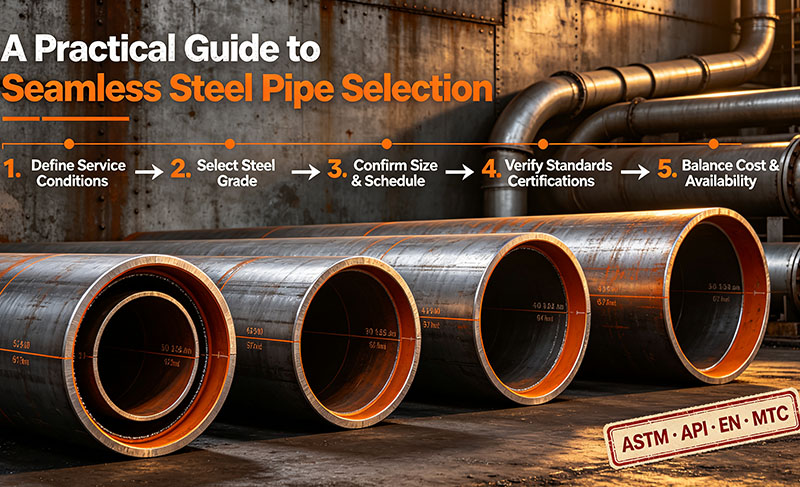


A Complete Guide to Selecting the Right Seamless Steel Pipe
2026/09/10
21
Seamless steel pipes are essential components in oil and gas, chemical processing, power generation, hydraulic systems, and industrial piping projects. Unlike welded steel pipes, they feature no longitudinal weld seams, delivering uniform structural strength, superior pressure resistance, and excellent durability under extreme working conditions. Choosing the correct seamless steel pipe is critical to ensuring project safety, extending service life, and controlling overall operational costs. This systematic guide elaborates on core selection principles and key influencing factors to help engineers and buyers make precise and cost-effective decisions.
1. Clarify Core Service Conditions (Primary Selection Basis)
All seamless pipe selections start with actual service conditions, which determine the basic material grade, pressure rating, and structural requirements. Four key factors must be confirmed first:
1.1 Operating Temperature
Temperature directly affects the mechanical properties and creep resistance of steel materials. For room-temperature conventional applications (0–100°C) such as water delivery and general compressed air systems, ordinary carbon steel seamless pipes are fully qualified. For high-temperature scenarios (above 350°C), including boiler pipelines, thermal power steam systems, and high-temperature chemical pipelines, heat-resistant alloy steel pipes like ASTM A335 P11, P12, and P22 are required to avoid thermal deformation and performance degradation. For low-temperature environments (below -20°C), low-temperature carbon steel or stainless steel pipes with qualified impact resistance must be selected to prevent brittle fracture.
1.2 Working Pressure
Seamless pipes are the preferred choice for high-pressure working conditions where welded pipes fail to meet safety standards. The working pressure determines the required pipe wall thickness and steel grade strength. Conventional low-pressure systems (below 3MPa) can adopt standard carbon steel pipes with ordinary wall thickness. For medium and high-pressure scenarios such as oil and gas transmission, hydraulic engineering, and petrochemical pipelines (above 10MPa), high-strength graded pipes (API 5L X42–X80 series) or thick-walled seamless pipes are necessary to ensure pressure-bearing stability and avoid pipe burst risks.
1.3 Transport Medium and Corrosiveness
The medium transported inside the pipe is a decisive factor for material selection. For non-corrosive media including clean water, steam, and ordinary fuel oil, carbon steel seamless pipes are the most cost-effective option. For corrosive media such as acid-base solutions, seawater, and sulfide-containing crude oil, anti-corrosion materials are mandatory. Austenitic stainless steel pipes (ASTM A312 TP304/TP316L) are suitable for general chemical corrosion and marine environments, while duplex steel and nickel-based alloy pipes are ideal for extreme corrosive working conditions with long-term service requirements.
1.4 Service Environment
Outdoor exposed, underground buried, and offshore working environments impose additional requirements on pipe performance. Buried pipelines need excellent anti-oxidation and soil corrosion resistance, usually equipped with external protective coatings such as 3LPE and FBE. Offshore and coastal high-humidity salt fog environments require high anti-corrosion steel grades or enhanced surface treatment to delay rusting and material aging.
2. Select Appropriate Steel Grade and Material Type
Based on confirmed service conditions, matching the right steel grade is the core step of seamless pipe selection. Common mainstream material grades and their applicable scenarios are summarized as follows:
2.1 Carbon Steel Seamless Pipes
As the most widely used and cost-effective type, carbon steel seamless pipes feature good plasticity, toughness, and processability. ASTM A106 Grade B is the universal grade for high-temperature water, steam, and general industrial piping systems, covering most conventional industrial scenarios. ASTM A53 Grade B is suitable for low-pressure fluid transmission and building piping. API 5L X-series grades (X42, X52, X65, X80) are specially designed for oil and gas long-distance transmission pipelines, with strength increasing sequentially to adapt to different pressure levels.
2.2 Alloy Steel Seamless Pipes
Alloy steel pipes add chromium, molybdenum, and other alloy elements to improve high-temperature resistance, pressure resistance, and creep resistance. Typical grades such as ASTM A335 P11/P12/P22 are widely used in power plant boilers, high-temperature chemical reaction pipelines, and superheated steam systems. This type of pipe is essential for high-temperature and high-pressure extreme working conditions where ordinary carbon steel pipes cannot sustain long-term stable operation.
2.3 Stainless Steel Seamless Pipes
Stainless steel seamless pipes excel in anti-corrosion, high-temperature oxidation resistance, and wear resistance. TP304 stainless steel is suitable for general corrosive environments and food-grade fluid transmission. TP316L low-carbon stainless steel performs better in anti-intergranular corrosion, ideal for chemical, pharmaceutical, and marine engineering scenarios. For ultra-high temperature and strong corrosion working conditions, high-grade stainless steel and duplex stainless steel pipes can be selected.
3. Confirm Accurate Size and Structural Parameters
Reasonable size matching ensures stable fluid transmission, low pressure loss, and structural safety. Key size parameters include outer diameter, wall thickness, pipe schedule, and length.
3.1 Outer Diameter and Pipe Schedule
Seamless pipe sizes follow NPS (Nominal Pipe Size) standards, with fixed outer diameters corresponding to different nominal diameters. The pipe schedule (SCH) determines the wall thickness: the higher the schedule number, the thicker the wall and the stronger the pressure-bearing capacity. Low-pressure fluid transmission usually adopts SCH40 standard wall thickness, while high-pressure industrial systems require SCH80, SCH160 or even thicker special wall thickness specifications. It is necessary to calculate flow velocity and pressure drop according to pipeline design requirements to select the optimal diameter and wall thickness combination.
3.2 Pipe Length and End Finish
Seamless pipes are available in single random length, double random length, and fixed customized lengths. Fixed-length pipes are convenient for on-site installation and reduce welding joints. For pipe end finishes, plain ends are suitable for general welding connection, beveled ends are designed for high-precision welding construction to ensure welding quality, and threaded ends are applied to small-diameter low-pressure pipeline connection scenarios.
4. Verify Industry Standards and Quality Certifications
Standard compliance and complete certifications are the fundamental guarantee of seamless pipe quality. Formal qualified seamless pipes must comply with international or industry-specific standards and provide complete inspection documents.
Common authoritative standards include ASTM standards for American standard pipes, API standards for petroleum pipelines, and EN European standards. During procurement, it is mandatory to require manufacturers to provide Mill Test Certificate (MTC) that meets EN 10204 3.1/3.2 standards, which records chemical composition, mechanical properties, pressure test data, and heat number of the pipe. For special scenarios such as sour oil and gas service, NACE MR0175 anti-sulfur certification is also required to ensure the pipe adapts to hydrogen sulfide-containing working environments and avoids sulfide stress cracking.
5. Balance Cost, Availability and Application Scenarios
While meeting performance requirements, economical selection is crucial. Carbon steel seamless pipes have the lowest cost and sufficient market supply, prioritized for conventional working conditions. Alloy and stainless steel pipes have higher performance but higher costs, only suitable for extreme temperature, high pressure, and strong corrosion scenarios to avoid over-investment.
In addition, delivery cycle and product availability should be considered. Conventional sizes and standard grades are in stock for fast delivery, while special specifications, customized lengths, and special alloy grades require longer production cycles, which need to be reserved in advance in project scheduling.
6. Final Selection Checklist
To avoid selection errors, complete the following verification before confirming the pipe model:
Confirm that the steel grade matches the operating temperature, pressure, and medium corrosion level
Verify that outer diameter, wall thickness and pipe schedule meet design pressure and flow requirements
Check that product standards and certification documents are complete and valid
Confirm pipe length, end finish and surface coating meet on-site installation requirements
Balance cost and performance to avoid under-specification safety risks or over-specification cost waste
Conclusion
Selecting a suitable seamless steel pipe is a systematic work combining working condition analysis, material performance matching, standard verification and economic evaluation. The core logic is to take service conditions as the foundation, select the most matching material specification and size on the premise of meeting safety and operational requirements, and finally realize the optimal balance of safety, stability and economy of the pipeline system. Following this scientific selection process can effectively avoid pipeline failure risks, reduce maintenance costs, and ensure long-term stable operation of industrial projects.