


A Comprehensive Guide to Solar Panel Bracket Steel Pipes: Classification, Performance, Treatment and
2026/09/11
17
Solar panel bracket steel pipe is a specialized structural steel product tailored for solar power generation systems. As the core load-bearing and supporting component of solar mounting structures, it sustains the static dead load of solar panels, as well as dynamic loads induced by wind pressure, snow accumulation and seismic activity. Unlike conventional steel pipes for fluid transmission, solar panel bracket pipes are engineered with a primary focus on structural stability, outdoor corrosion resistance, wind resistance and assembly precision. Driven by the booming global new energy industry, standardized, high-quality solar panel bracket steel pipes have become a pivotal guarantee for the long-term safe operation and low maintenance cost of solar power stations. This paper provides a systematic overview of solar panel bracket steel pipes, covering their definition, classification, core performance indicators, surface treatment technologies, application scenarios and professional selection criteria.
1. Definition of Solar Panel Bracket Steel Pipe
Solar panel bracket steel pipe refers to a series of profiled steel pipes exclusively manufactured for solar panel mounting frames, support columns, cross beams, diagonal braces and fixed connection structures. Classified as structural engineering steel pipe rather than pressure-bearing fluid pipe, it is designed to prioritize mechanical load resistance, outdoor weather adaptability and modular assembly performance.
Most solar bracket steel pipes adopt welded hot-rolled carbon steel as the base material with standardized wall thickness and section specifications. Processed with rigorous anti-corrosion surface treatment, they can withstand long-term outdoor exposure and adapt to complex harsh environments including deserts, coastal areas and mountainous regions. This enables solar power stations to achieve a service life of 25 to 30 years, fully matching the full life cycle of solar power generation equipment.
2. Common Classification of Solar Panel Bracket Steel Pipes
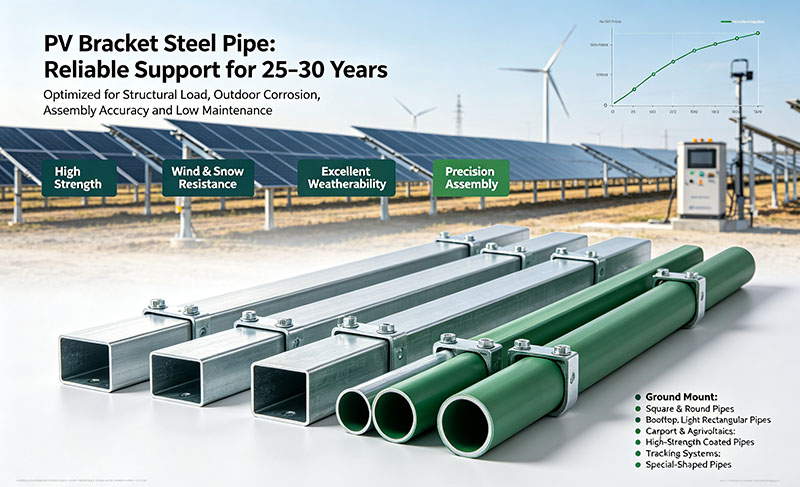
Based on cross-sectional shape and structural functional characteristics, solar panel bracket steel pipes are mainly divided into four categories, which are applicable to different types of solar power stations and differentiated load requirements:
2.1 Square Steel Pipe
As the most widely used type for solar panel brackets, square steel pipes cover mainstream specifications such as 40×40mm, 50×50mm, 60×60mm and 80×80mm. Featuring uniform stress distribution, excellent torsional resistance and high structural rigidity, they are ideal for main support columns and primary cross beams of ground-mounted power stations, rooftop distributed solar systems and solar carport projects. Their regular cross-section facilitates punching, cutting and modular assembly, significantly improving on-site construction efficiency.
2.2 Rectangular Steel Pipe
Rectangular steel pipes feature asymmetric sectional strength with superior vertical bending resistance. They are primarily applied to auxiliary cross beams, purlins and connecting supports of solar panel brackets. While meeting standard load-bearing requirements, they effectively reduce structural self-weight, making them widely adopted in lightweight rooftop solar projects with limited building bearing capacity.
2.3 Round Steel Pipe
Round solar bracket steel pipes deliver outstanding wind resistance and balanced omnidirectional stress performance, which can effectively mitigate wind load impact. They are commonly used for vertical support columns of large-scale ground solar power stations, agricultural photovoltaic greenhouses and mountain solar projects, adapting to high-wind and complex terrain conditions.
2.4 Special-Shaped Profiled Steel Pipe
Special-shaped profiled steel pipes include octagonal pipes, slotted pipes and customized profiled products, which are mainly matched with high-end solar tracking support systems. The optimized cross-sectional structure enhances overall structural stability and assembly accuracy, suitable for high-precision automatic tracking solar power stations and large-scale industrial new energy projects.
3. Main Material Grades and Industry Standards
To adapt to long-term outdoor dynamic loads, solar panel bracket steel pipes require strict standardized mechanical properties for base materials. The mainstream steel grades and authoritative industry standards are specified as follows:
Common Steel Grades: Q235B and Q355B low-alloy high-strength steel are the mainstream domestic options. International equivalent grades include ASTM A500 Grade B/C, S235JR and S355JR, which cater to different structural load and wind resistance design requirements.
Core Implementation Standards: GB/T 6728, GB/T 13793, ASTM A500, EN 10219, NB/T 10115-2018 Solar Support Design Specification, and ASCE 7-22 Wind and Snow Load Design Standard. These standardized specifications ensure product structural safety and batch consistency.
4. Main Surface Anti-Corrosion Treatment Technologies
The service life of solar panel brackets is largely determined by surface anti-corrosion treatment. Long-term outdoor operation requires strong resistance to UV aging, rain erosion, atmospheric oxidation and salt fog corrosion. The three mainstream surface treatment processes are detailed below:
4.1 Hot-Dip Galvanizing (HDG)
Hot-dip galvanizing is the most traditional and highly reliable treatment process for solar brackets. The steel pipe is immersed in high-temperature molten zinc to form a dense metallurgical zinc layer with a thickness of 85–120μm. Boasting strong coating adhesion, excellent scratch resistance and ultra-long anti-corrosion lifespan, it is applicable to deserts, coastal areas, high-altitude regions and other high-corrosion environments, with a service life of over 25 years.
4.2 Zinc-Aluminum-Magnesium (ZAM) Coating
As an innovative high-efficiency anti-corrosion process, ZAM coating adopts a composite alloy layer composed of zinc, aluminum and magnesium. It features self-repairing performance for cutting notches and surface scratches with superior salt fog resistance compared with conventional galvanizing. The coating is thin, uniform and free of zinc ash, presenting an aesthetic surface and lower long-term maintenance costs, making it the mainstream process for new high-standard solar power stations.
4.3 Powder Spraying and Painting
This process is mainly applied to indoor solar facilities and urban rooftop solar projects with low corrosion resistance requirements. It provides a smooth, aesthetic surface with rich color options, but its anti-corrosion performance is inferior to hot-dip galvanizing and ZAM coating. It is only suitable for light-load and low-corrosion working conditions.
5. Core Performance Requirements
5.1 Excellent Wind and Snow Load Resistance
Solar power stations operate outdoors continuously. The supporting steel pipes must possess high tensile strength, yield strength and bending toughness to withstand extreme weather such as strong gales, heavy snow and hail, preventing structural deformation, inclination or collapse.
5.2 Long-Term Outdoor Weather Resistance
Qualified anti-corrosion coatings can effectively resist UV radiation, alternating temperature changes, rainwater erosion and atmospheric corrosion, ensuring no obvious rust generation or performance attenuation during the 25–30 year power generation cycle.
5.3 High Dimensional Assembly Accuracy
Solar panel brackets adopt modular standardized assembly modes. The straightness, section tolerance, hole position accuracy and length error of steel pipes must comply with strict standards, so as to realize seamless on-site component docking, improve installation efficiency and eliminate structural assembly gaps.
5.4 Superior Welding and Processing Performance
Steel pipes need to undergo multiple processing procedures including cutting, punching, bending and welding. Stable material plasticity and weldability avoid cracking and deformation during processing, and ensure high structural strength of welding joints to meet overall load-bearing demands.
5.5 Lightweight and High-Strength Properties
On the premise of meeting safety load standards, high-strength low-alloy steel pipes reduce structural self-weight, lower foundation bearing requirements and cut project costs. They are adaptable to complex application scenarios such as building rooftops, hillsides and tidal flats.
6. Typical Application Scenarios
Ground-Mounted Solar Power Stations: Large-scale centralized power stations located in plains, deserts and mountainous areas adopt high-strength square and round galvanized steel pipes as main supports to resist extreme wind and snow loads.
Rooftop Distributed Solar Systems: Widely used for industrial plant, commercial building and residential rooftop power stations, lightweight rectangular and square steel pipes are adopted to reduce building bearing pressure.
Solar Carports: Applied in integrated parking lot power generation and shading projects, requiring high structural rigidity and attractive appearance, matched with premium zinc-aluminum-magnesium anti-corrosion treatment.
Agrivoltaic and Aquavoltaic Systems: Used for agricultural photovoltaic greenhouses and fishery-photovoltaic complementary power stations. High weather-resistant coated steel pipes are prioritized to adapt to humid and multi-corrosion environments.
Solar Tracking Systems: Equipped on automatic angle-adjusting solar brackets, high-precision special-shaped steel pipes are used to guarantee the long-term stable operation of mechanical transmission structures.
7. Professional Selection Guidelines
Material Grade Matching by Load: Q235B steel is suitable for conventional light and medium-load projects; Q355B high-strength steel is recommended for heavy-load areas and regions with severe wind and snow weather to improve structural safety margin.
Anti-Corrosion Process Selection by Environment: ZAM coating is adopted for coastal salt fog, humid and high-corrosion areas; hot-dip galvanizing is applicable to deserts and inland open areas; powder spraying is suitable for urban rooftop solar projects focusing on decorative effects.
Section Optimization by Usage: Square pipes for main load-bearing beams and columns; rectangular pipes for auxiliary purlins; round pipes for wind-resistant vertical supports; special-shaped pipes for high-end tracking systems.
Standardized Specification Matching: Select wall thickness ranging from 1.5mm to 3.0mm according to design loads, with 2.0–2.5mm as the universal standard thickness for conventional projects. Prioritize products compliant with national and international industry standards.
Quality Certification Verification: Complete mill test reports, coating thickness detection reports and structural performance test reports are required to ensure batch product stability and smooth project acceptance.
Life Cycle Cost Balance: High-standard anti-corrosion materials feature slightly higher initial investment but effectively reduce later maintenance and replacement costs, meeting the long-term operational requirements of solar power stations.
8. Limitations and Engineering Precautions
Low-quality uncoated cold-rolled steel pipes are prohibited for outdoor solar panel bracket applications, as they are prone to rapid rusting and structural failure, failing to meet long-term operational requirements.
Coating damage caused by cutting, welding and drilling during processing must be repaired with zinc-rich paint or special repair agents to prevent local rust spread.
Thickened coatings or enhanced anti-corrosion processes must be adopted in high-temperature, high-humidity and high-corrosion areas to extend service life.
The wall thickness and section size of steel pipes shall not be arbitrarily reduced for cost saving, so as to avoid safety hazards caused by insufficient wind and snow resistance.
Conclusion
Solar panel bracket steel pipes serve as the fundamental structural guarantee for the safe and stable operation of solar power generation systems. Different from traditional fluid conveying steel pipes, they take structural load resistance, outdoor weather resistance and long-term durability as core performance indicators. In engineering selection, steel grades, pipe types, anti-corrosion processes and specification parameters should be comprehensively matched according to regional climate conditions, environmental corrosion degree, project type and load design standards. Scientific and standardized selection of solar panel bracket steel pipes can effectively support the 25–30 year stable power generation cycle of solar power stations, reduce operation and maintenance costs, and maximize the economic benefits of new energy projects.
Related news
-
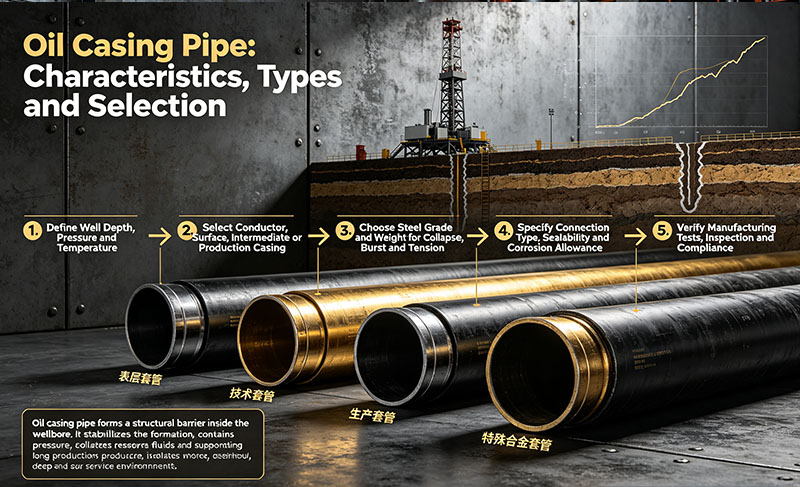
Oil Casing Pipe: Types, Steel Grades, Performance and Oilfield Selection Guide
Oil casing pipe is a core special seamless steel pipe used in petroleum and natural gas drilling and production engineering. As the main structural barrier of oil and gas wells, it runs through the entire wellbore and undertakes critical functions such as stratum support, well wall stabilization, pressure isolation, -
A Comprehensive Guide to Solar Panel Bracket Steel Pipes: Classification, Performance, Treatment and
Solar panel bracket steel pipe is a specialized structural steel product tailored for solar power generation systems. As the core load-bearing and supporting component of solar mounting structures, it sustains the static dead load of solar panels, as well as dynamic loads induced by wind pressure, snow accumulation and seismic activity. -
Solar Panel Bracket Steel Pipe: Definition, Classification, Performance and Selection Guidelines
Solar panel bracket steel pipe is a dedicated structural steel product for solar power generation systems. Serving as the core load-bearing and supporting component of solar mounting structures, it undertakes the dead load of solar panels, as well as dynamic loads such as wind pressure