


1. What Is Oil Casing Pipe?
2. Well Casing Hierarchical Structure (Well Body Composition)
2.1 Conductor Casing
2.2 Surface Casing
2.3 Intermediate Casing (Technical Casing)
2.4 Production Casing
3. Main API Steel Grades and Performance Characteristics
3.1 Conventional Carbon Steel Casing
3.2 High-Strength Casing
3.3 Corrosion-Resistant Special Casing
4. Common Thread Connection Types
STC (Short Thread): Short round thread, low cost, convenient processing, suitable for shallow and medium-depth conventional wells with low sealing requirements.
LTC (Long Thread): Long round thread, longer connection length, higher tensile strength and better sealing performance, suitable for medium and deep wells with high load requirements.
BTC (Buttress Thread): Trapezoidal premium thread, with ultra-high tensile strength, pressure resistance and anti-tripping performance, excellent sealing effect, specially used for deep wells, ultra-deep wells and high-pressure gas wells.
5. Core Performance Advantages of Oil Casing
5.1 High Collapse Resistance
5.2 Excellent Internal Pressure Resistance
5.3 Strong Stress Corrosion Resistance
5.4 High Tensile Strength
5.5 Strict Dimensional and Structural Stability
6. Typical Application Scenarios
Onshore Conventional Oil and Gas Fields: J55, N80 and P110 casings are used for shallow, medium and deep well development to meet conventional drilling and production needs.
High-Sulfur Corrosive Oil and Gas Wells: L80, C90 anti-corrosion casings are adopted to adapt to hydrogen sulfide and carbon dioxide corrosive environments and avoid pipe corrosion failure.
Deep and Ultra-Deep Wells: P110, VM110 high-strength casings are used to resist extreme stratum pressure and complex ground stress.
Offshore Oil and Gas Projects: Premium high-strength and corrosion-resistant casings are selected to adapt to marine salt fog, brine erosion and severe wave load environments.
Unconventional Energy Wells: Applied to shale gas, tight oil and coalbed methane wells, adapting to fracturing impact and complex wellbore stress changes.
7. Professional Oilfield Selection Guidelines
Match Steel Grade with Well Depth: Select J55 for shallow wells within 1000m; N80 for medium-depth wells of 1000–3000m; P110 for deep wells above 3000m; ultra-high-strength steel grades for ultra-deep wells.
Select Corrosion Grade According to Medium: Use conventional steel grades for non-corrosive fresh water and conventional oil and gas; adopt L80/C90 anti-sulfur casings for H2S and CO2 containing corrosive wells.
Optimize Thread Type by Pressure Level: Choose STC thread for low-pressure shallow wells; LTC thread for medium-load medium-depth wells; BTC premium thread for high-pressure deep wells and gas wells to ensure sealing reliability.
Reasonably Match Wall Thickness: Appropriately increase wall thickness for wells with large stratum pressure and unstable geology to improve collapse resistance and safety margin.
Strictly Comply with API 5CT Standards: Verify chemical composition, mechanical properties, hydraulic pressure test, flaw detection and dimensional tolerance to ensure compliance with international oilfield specifications.
Balance Safety and Economy: Avoid over-grade configuration for conventional wells to control costs; strictly adopt high-grade anti-corrosion and high-strength casings for high-risk complex wells to eliminate safety hazards.
8. Key Engineering Notes
Casing pipes must be protected from collision and thread damage during transportation and hoisting, otherwise it will affect downhole assembly and sealing performance.
Strict thread cleaning and oiling protection must be carried out before running the casing to prevent sundries from entering the thread and causing sealing failure.
For corrosive well sections, matched anti-corrosion casing and auxiliary protective measures must be adopted, and ordinary casing is prohibited from being used alternatively.
Cementing quality directly affects the overall stress of the casing string. Unqualified cementing will lead to local stress concentration and casing deformation or rupture.
Conclusion
Related news
-
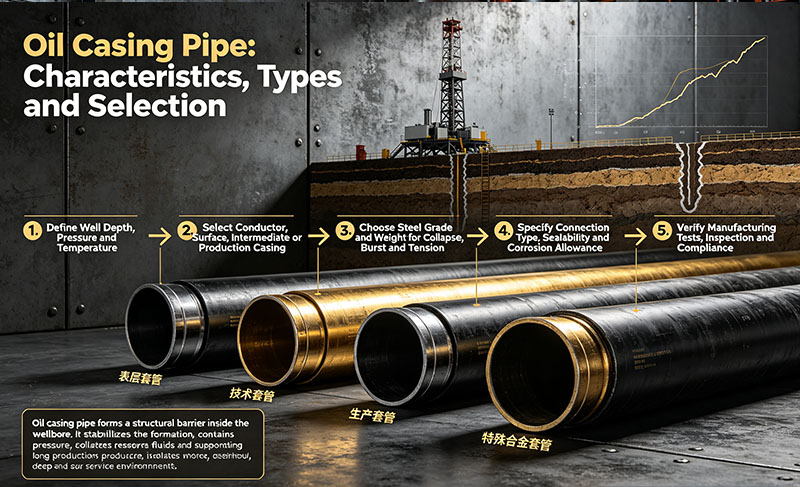
Oil Casing Pipe: Types, Steel Grades, Performance and Oilfield Selection Guide
Oil casing pipe is a core special seamless steel pipe used in petroleum and natural gas drilling and production engineering. As the main structural barrier of oil and gas wells, it runs through the entire wellbore and undertakes critical functions such as stratum support, well wall stabilization, pressure isolation, -
A Comprehensive Guide to Solar Panel Bracket Steel Pipes: Classification, Performance, Treatment and
Solar panel bracket steel pipe is a specialized structural steel product tailored for solar power generation systems. As the core load-bearing and supporting component of solar mounting structures, it sustains the static dead load of solar panels, as well as dynamic loads induced by wind pressure, snow accumulation and seismic activity. -
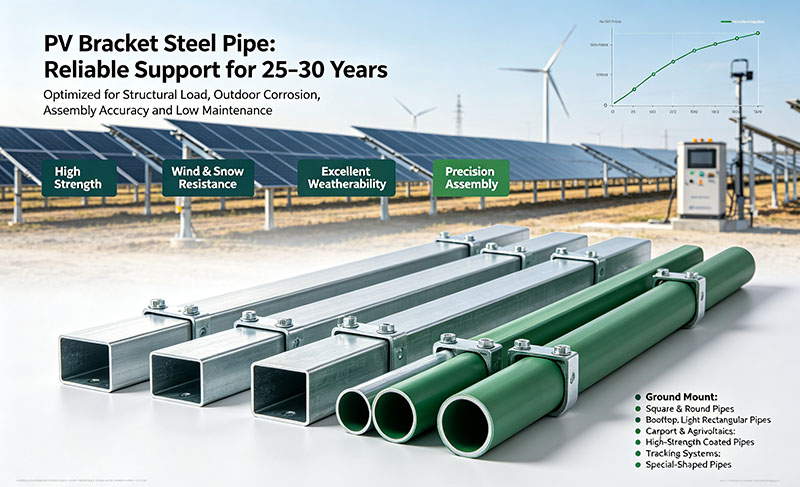
Solar Panel Bracket Steel Pipe: Definition, Classification, Performance and Selection Guidelines
Solar panel bracket steel pipe is a dedicated structural steel product for solar power generation systems. Serving as the core load-bearing and supporting component of solar mounting structures, it undertakes the dead load of solar panels, as well as dynamic loads such as wind pressure